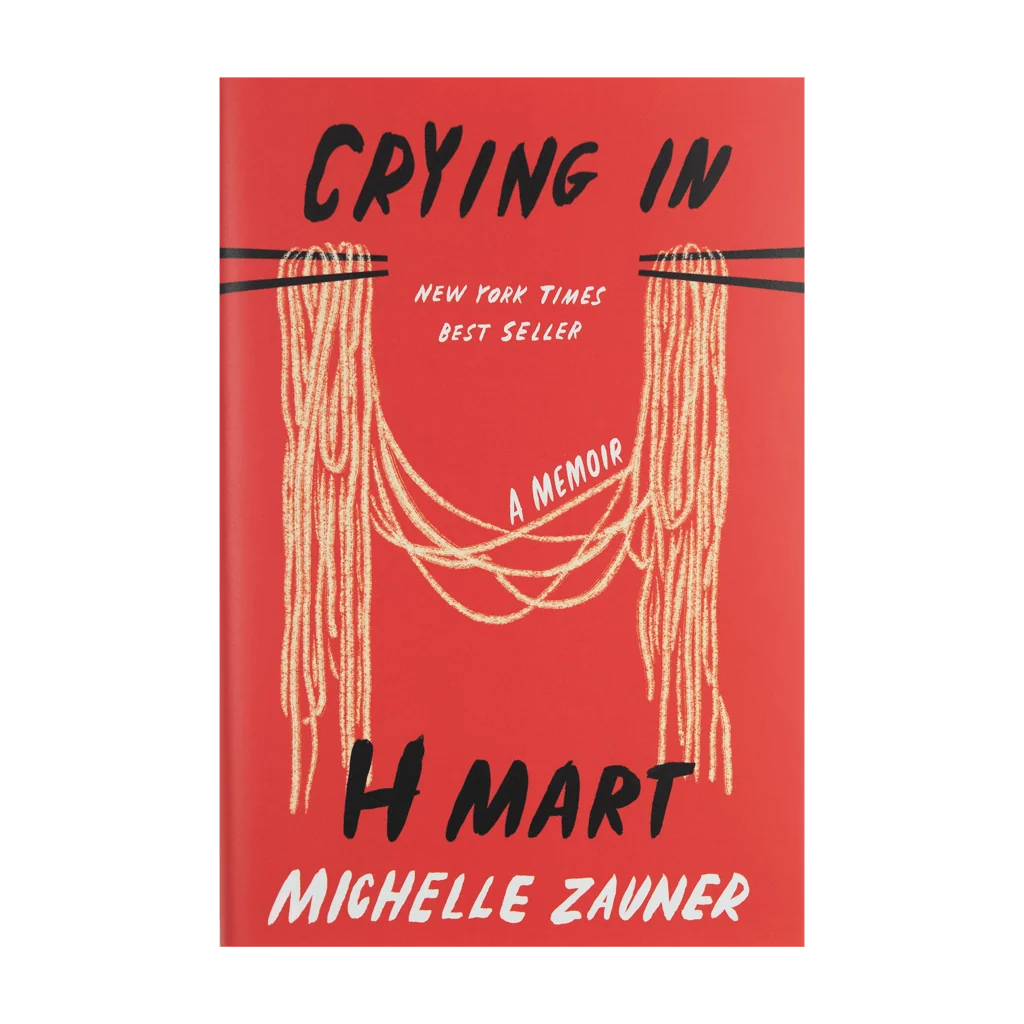
Michelle Zauner, Crying in H Mart (2021)
Content warning:
Death of a parent, discrimination and bigotry, domestic violence, hospitalization, pregnancy loss, serious injury, sexual assault
Synopsis
In this memoir, Michelle Zauner pays tribute to her late mother. Zauner grew up in Eugene with her Korean mother and white American father. The stories Zauner includes about her childhood indicate that her mother, and occasional visits to her mother’s family in Seoul, were the primary ways she connected with her Korean heritage. Food, one of her mother’s greatest joys in life, was particularly central. At twenty-five, Zauner is a struggling musician in Philadelphia; when her mother is diagnosed with cancer, she moves back to Eugene to care for her. In harrowing detail, Zauner chronicles supporting her mother through painful treatment, her rush to plan her own wedding once her mother’s prognosis is terminal, and eventually, her mother’s death. After her mother’s passing, Zauner processes her grief through food, learning to cook some of her mother’s favorite dishes through watching YouTube sensation Maangchi and, as the title indicates, crying in the Korean supermarket H Mart.
Essay
I find that Crying in H Mart represents a very unusual case—a book bringing significantly more attention to an artist’s musical output, and not the other way around. I’ll annoyingly let you know that I’d been a fan of Zauner’s music for years before Crying in H Mart—even before the New Yorker essay version, also “Crying in H Mart” (which went viral and helped Zauner land her book deal) came out in 2018. Crying in H Mart, which was second on the New York Times nonfiction bestseller list the week it was released, and remained on the list for over a year, has got to be one of the most popular contemporary works by an Oregon author, and it garnered more recognition from students than most other texts I put on my course syllabus.
A large portion of the memoir—stories of Zauner’s childhood, most of her mother’s struggle with cancer, and the immediate aftermath of her mother’s death—is set in Eugene. Zauner describes the family’s five acres of land outside the city, where she grew up “an only child with no one to talk to or turn to but my mother” (which led me, before I moved to the Willamette Valley, to think of Eugene as far more rural than it is) (16). She mentions her mother getting treated at Riverbend Hospital, a recurring nightmare that her parents would drive off the Ferry Street Bridge. Details of Eugene run throughout the book’s fabric.
Yet Eugene is never as vivid a setting as the H Mart in the first chapter, adapted from Zauner’s New Yorker essay. There, Zauner recounts every detail, from a rundown of all the usual food stalls to the activities of fellow shoppers, like a kid “double-fisting plastic sleeves of ppeongtwigi” (5). There are only two H Marts in Oregon, and both are in metro Portland. The H Marts that appear in the memoir are in greater Philadelphia and New York City. Zauner acknowledges that H Mart was not a part of her childhood—“There was no H Mart in Eugene. Instead, twice a week my mother and I would go shopping for Korean groceries at Sunrise Market, a small business in town run by a Korean family” (78-79). This store and the restaurant Café Seoul, both locally owned businesses, were how Zauner and her mother connected to Korean food in Eugene. Over either of them, though, Zauner chooses to center H Mart, both at the memoir’s outset and towards its end. A meaningful visit to Seoul—a place she describes as “the opposite of Eugene”—concludes the book (24). Eugene, steeped in childhood memories and haunted with images of her mother near death, becomes a place to leave behind. While it shapes Zauner’s upbringing and her mother’s final days, the local context falls away from the grief story. Her father sells the family home. Big-city, global signifiers—buying supplies from H Mart to make kimchi in her Brooklyn apartment, sharing a meal with relatives in Seoul—are how Zauner continues to honor her mother’s legacy as she leaves her hometown behind.
Author Bio
Michelle Zauner was born in 1989 in Seoul, South Korea. When she was a year old, the family moved to Eugene, Oregon, where she grew up. Zauner attended Bryn Mawr College and while there, began her musical career. After serving as the frontwoman of the band Little Big League, she began recording solo music as Japanese Breakfast. Her first album as Japanese Breakfast, Psychopomp (2016), as Crying in H Mart later would, addresses the loss of her mother. She has released three more albums, most recently For Melancholy Brunettes (and Sad Women) (2025), as well as a video game soundtrack. Crying in H Mart was her first book.
Further Reading
Nicole Chung, A Living Remedy (2023)
- Memoir about caring for ill parents, Korean American Oregon author
Garrett Hongo, Ocean of Clouds (2025)
- Collection by a Eugene-based Asian American poet